Tuesday, January 11, 2022

The Fat Man - "Murder Shows A Phantom Face" (04-07-55)

 Murder Shows A Phantom Face (Aired April 7, 1955)


"There he goes across the street into the drugstore, steps on the scale, height: 6 feet, weight: 290 pounds, fortune: Danger. Who isit? THE FAT MAN." Brad Runyon was the Fat Man, played by Jack Scott Smart. The series was created by Dashall Hammott and was first heard on the ABC network Jan. 21, 1946. J. Scott Smart fit the part of the Fat Man perfectly, weighing in at 270 pounds himself. When he spoke, there was no doubt that this was the voice of a big guy. Smart gave a witty, tongue-in-cheek performance and helped make THE FAT MAN one of the most popular detective programs on the air. Smart also appeared in The March Of Time (early 1930s), the Theater Guild On The Air, Blondie, The Fred Allen Show, and The Jack Benny Program. There was also an version made in Australia, syndicated on the Artansa lable, about 1954. There are at least 36 shows available from vendors. The Australian Fat Man was played possibly by Lloyd Berrell. Although not featuring J. Scott Smart, who really fit the part, the series is quite good. 


THIS EPISODE:


April 7, 1955. Program #34. Grace Gibson syndication (Australia). "Murder Shows A Phantom Face". Commercials added locally. Lloyd Berrill, Grace Gibson (producer), Dashiell Hammett (creator). 26:10. Episode Notes From The Radio Gold Index.

The Fibber McGee & Molly Show - "Fibber Cuts Down Jesse James Tree" (01-17-50)

The Moonglows-"We Go Together" (March 1956)
Fibber Cuts Down Jesse James Tree (Aired January 17, 1950)


The program struggled in the ratings until 1940, when it became a national sensation. Within three years, it was the top-rated program in America. Few radio shows were more beloved than Fibber McGee and Molly. The program’s lovable characters included Mayor LaTrivia, Doc Gamble, Mrs. Uppington, Wallace Wimple, Alice Darling, Gildersleeve, Beulah, Myrt, and the Old Timer. 79 Wistful Vista was one of America’s most famous addresses and Molly’s warning to Fibber not to open the hall closet door (and his subsequent decision to do it) created one of radio’s best remembered running gags that audiences expected each week. Jim Jordan (Fibber) was born on a farm on November 16, 1896, near Peoria, Illinois. Marian Driscoll (Molly), a coal miner’s daughter, was born in Peoria on November 15, 1898. After years of hardship and touring in obscurity on the small-time show biz circuit, they arrived in Chicago in 1924, where they eventually performed on thousands of shows and developed 145 different voices and characters.


THIS EPISODE:


January 17, 1950. NBC network. Sponsored by: Johnson's Wax. "Fibber Cuts Down Jesse James Tree" for a "free" supply of firewood. Arthur Q. Bryan, Bill Thompson, Billy Mills and His Orchestra, Cliff Arquette, Don Quinn (writer), Elvia Allman, Gale Gordon, Harlow Wilcox, Herb Vigran, Jim Jordan, Marian Jordan, Phil Leslie (writer), Richard LeGrand, The King's Men. 29:34. Episode Notes From The Radio Gold Index.


Casey Crime Photographer - "Unlucky Numbers" (06-15-50)

Unlucky Numbers (Aired June 15, 1950)

Casey, whose first name was never revealed, was the major crime photographer at the fictional Morning Express newspaper. With the help of reporter Ann Williams, he tracked down criminals and solved numerous crimes on this popular mystery-adventure series. Often a picture snapped at a crime scene led Casey to play detective. Jackson Beck and Bernard Lenrow were heard as Captian Logan and John Gibson played Ethelbert. Sponsors included Anchor-Hocking glass, Toni home permanet, Toni Creme Shampoo and Philip Morris cigarettes.   Richard Carlyle and John Gibson portrayed the roles when the series premiered in April, 1951, but by June they were replaced by Darren McGavin and Cliff Hall. Ann Williams, a reporter on The Morning Express, was Casey’s girlfriend. During the summer of 1951 he acquired a partner in cub reporter Jack Lipman, who wrote copy to go with Casey’s pictures. This live series was set in and broadcast from, New York City. Show Notes From The Old Time Radio Researcher's Group.


THIS EPISODE:


June 15, 1950. CBS network origination, AFRS rebroardcast. "Unlucky Number(s)". Staats Cotsworth ; John Gibson; Ken Roberts (AFRS announcer); Jan Miner; Herman Chittison (pianist); Archie Bleyer (composer); John Dietz (director); Alonzo Deen Cole (writer); George Harmon Coxe (creator);. 24:16 Episode Notes From The Radio Gold Index.

Crime Classics - "The Axe And The Droot Family" (08-10-53)

The Axe And The Droot Family (Aired August 10, 1953)

Crime Classics was a U. S. radio docudrama which aired over CBS from June 15, 1953 to June 30, 1954. Created, produced, and directed by radio actor/director Elliott Lewis, the program was basically a historical true crime series, examining crimes, and especially murders, from the past. It grew out of Lewis's personal interest in famous murder cases, and took a documentary-like approach to the subject, carefully recreating the facts, personages, and feel of the time period. Comparatively little dramatic license was taken with the facts and events, but the tragedy was leavened with humor, expressed largely through the narration.


 THIS EPISODE:


August 10, 1953. CBS network. "The Axe and The Droot Family: How They Fared". Sustaining. In Pennsylvania in 1795, the shortest distance to an inheritance is two crushed skulls. This is a network version. Lou Merrill (host), Morton Fine (writer), David Friedkin (writer), Elliott Lewis (producer, director), Bernard Herrmann (composer, conductor), Mary Jane Croft, Clayton Post, Herb Butterfield, Sam Edwards, Paul Frees, Charles Davis, George Walsh (announcer). 30:08. Episode Notes From The Radio Gold Index.

Big Town (Starring Edward G. Robinson) - "Pittsburgh Lil" (10-19-37)

Pittsburgh Lil (Aired October 19, 1937)

Hard-nosed editor, Wilson, as played by Robinson would get the story no matter what it takes. Though sometimes over the top, Robinson was excellent in his role. The stories were well written and directed by William N. Robson as well as McGill. The skill of this group shows in making the series very good radio. The show was a big promoter of the free press and the first amendment with its opening sequence: "Freedom of the press is a flaming sword! Use it justly...hold it high...guard it well!" The second series began immediately in the 1943 season when the production moved from Hollywood to New York. Robinson left (Trevor left two years earlier as her career starting taking off) and McGill reorganized the series placing Edward Pawley in the role of Wilson opposite Fran Carlon as Lorelei. Pawley's Wilson was more mellifluous compared to the rather nasty Robinson.


THIS EPISODE:


October 19, 1937. CBS network. Sponsored by: Rinso. The first show of the series. Steve Wilson is portrayed as a throughly unpleasant scandal-monger who decides to reveal that Mrs. Radsmith, a noted socialite in Big Town, is really "Pittsburgh Lil" from Alaska. Edward G. Robinson, Claire Trevor, Hanley Stafford, Paula Winslowe, Bill Wright, Carlton KaDell (announcer). 28:31. Episode Notes From The Radio Gold Index.

Monday, January 10, 2022

Blair Of The Mounties - 2 Episodes (01-31-38) and (02-07-38)

 2 Episodes - "Fire Valley" (01-31-38) and "Murder In Long Cooley" (02-07-38)


Blair of the Mounties is the story of the Royal Northwest Mounted Police -- a fictional series based on the work of the Northwest Mounted Police before the World War I. It was a fifteen minute weekly serial heard every Monday for 36 weeks beginning January 31st, 1938 and running through the 3rd of October of 1938. It may have been on the air as early as 1935, although there’s no actual proof of this. Little is known of the series other than it followed the exploits of Sgt. Blair of the Northwest Mounted Police. and probably was the inspiration for Trendell, Campbell and Muir's Challenge of the Yukon. The series was written by Colonel Rhys Davies, who also played the Colonel Blair in the series. Jack Abbot played the Constable. Jack French, one of OTR’s best researchers says this about the series: “Blair is not restricted to Canada, as other Mounties, as we find him, in a few cases, in Great Britain, solving cases. Overall the series is amateurishly written, with the actor playing Blair coming accros as a bit stuffy.”


TWO EPISODES:

Blair Of The Mounties. January 31, 1938. Program #1. Walter Biddick syndication. "Fire Valley". Corporal Lesley has been, "Stolen Away By Ghosts." . 12:37. 


February 7, 1938. Program #2. Walter Biddick syndication. "Murder In Long Cooley". Belle La Tour is on the trail to Fort MacAllister...during a blizzard. . 12:00.

Barry Craig Confidential Investigator - "Scream For Murder" (07-19-53)

Scream For Murder (Aired July, 1953)

Originally aired October 31, 1951 Barry Craig, Confidential Investigator is one of the few detective radio series that had separate versions of it broadcast from both coasts. Even the spelling changed over the years. It was first "Barry Crane" and then "Barrie Craig". NBC produced it in New York from 1951 to 1954 and then moved it to Hollywood where it aired from 1954 to 1955. It attracted only occasional sponsors so it was usually a sustainer. William Gargan, who also played the better known television (and radio) detective Martin Kane, was the voice of New York eye Barry Craig while Ralph Bell portrayed his associate, Lt. Travis Rogers. Craig's office was on Madison Avenue and his adventures were fairly standard PI fare. He worked alone, solved cases efficiently, and feared no man. As the promos went, he was "your man when you can't go to the cops. Confidentiality a speciality." Like Sam Spade, Craig narrated his stories, in addition to being the leading character in this 30 minute show. As an actor, William Gargan had played Ellery Queen in three movies, before being cast as Kane. After he left Martin Kane, Gargan landed on his feet. He signed a million dollar, seven year contract with MCA for the radio show Barry Craig, Confidential Investigator on NBC. 


THIS EPISODE:


July 19, 1953. NBC network. "Scream For Murder". "A squabbling couple can always bury their differences. The question is, which of them doesn't mind an underground shelter? Marriages may be made in heaven, but they sometimes end up in the city morgue. William Gargan; John Roberts (writer); Don Pardo (announcer); Fran Carlon; Himan Brown (director);. 29:35 Episode Noyes From The Radio Gold Index.

Sunday, January 09, 2022

The Adventures Of Sam Spade - "The Wheel Of Life Caper" (07-11-48)

The Wheel Of Life Caper (Aired July 11, 1948)

The Adventures of Sam Spade was a radio series based loosely on the private detective character Sam Spade, created by writer Dashiell Hammett for The Maltese Falcon. The show ran for 13 episodes on ABC in 1946, for 157 episodes on CBS in 1946-1949, and finally for 51 episodes on NBC in 1949-1951. The series starred Howard Duff (and later, Steve Dunne) as Sam Spade and Lurene Tuttle as his secretary Effie, and took a considerably more tongue-in-cheek approach to the character than the novel or movie. In 1947, scriptwriters Jason James and Bob Tallman received an Edgar Award for Best Radio Drama from the Mystery Writers of America. Before the series, Sam Spade had been played in radio adaptations of The Maltese Falcon by both Edward G. Robinson (in a 1943 Lux Radio Theater production) and by Bogart himself (in a 1946 Academy Award Theater production), both on CBS.


THIS EPISODE:

 
July 11, 1948. CBS network. "The Wheel Of Life Caper". Sponsored by: Wildroot Cream-Oil. Sam meets a mystery woman with no memory and a corpse that's been killed by a buzz saw! Sandra Gould replaces Lurene Tuttle as Effie, Sam's secretary. Howard Duff, Dashiell Hammett (creator), William Spier (producer, director), Sandra Gould, Gil Doud (writer), Robert Tallman (writer), Lud Gluskin (music director), Dick Joy (announcer). 28:50. Episode Notes From The Radio Gold Index.

The Adventures Of Philip Marlowe - "The Busy Body" (06-18-49)

The Busy Body (Aired June 18, 1949)


Dashiell Hammett introduced the new genre, and Sam Spade, in 1930 in his novel The Maltese Falcon. A few years later Raymond Chandler came along and perfected the type, with his detective, Philip Marlowe. Chandler introduced Marlowe in his first novel, The Big Sleep, and Philip Marlowe continued to solve crimes in six subsequent Chandler novels. Chandler had previously published a number of short stories featuring other detectives; however, Marlowe proved so popular that when the stories were later republished the author often switched the detectives to Philip Marlowe. Chandler's style was unique. His sparse style was full of wonderfully sharp similies and rich descriptive narration.


THIS EPISODE:


 June 18, 1949. Program #38. CBS network. "The Busy Body". Sustaining. A corpse that keeps moving around and a nosey neighbor helps to solve a murder case. Gene Levitt (writer), Gerald Mohr, John Stevenson, Laurette Fillbrandt, Lois Corbett, Lynn Allen, Mel Dinelli (writer), Norman Macdonnell (producer, director), Peter Leeds, Raymond Chandler (creator), Richard Aurandt (music), Robert Mitchell (writer), Roy Rowan (announcer). 29:43. Episode Notes From Boxcars711 OTR.

The Aldrich Family - "War Bonds" (04-01-43)

War Bonds (Aired April 1, 1943)

The Aldrich Family as a separate radio show was born as a summer replacement for Jack Benny in NBC's Sunday night lineup, July 2, 1939, and it stayed there until October 1, 1939, when it moved to Tuesday nights at 8 p.m., sponsored by General Foods's popular gelatin dessert Jell-O---which also sponsored Jack Benny at the time. The Aldriches ran in that slot from October 10, 1939 until May 28, 1940, moving to Thursdays, from July 4, 1940 until July 20, 1944. After a brief hiatus, the show moved to CBS, running on Fridays from September 1, 1944 until August 30, 1946 with sponsors Grape Nuts and Jell-O,.before moving back to NBC from September 05, 1946 to June 28, 1951 on Thursdays and, then, its final run of September 21, 1952 to April 19, 1953 on Sundays.


THIS EPISODE: 


April 1, 1943. NBC network. Sponsored by: Postum. Henry and Homer are out selling "War Bonds"...in a snowstorm....with a cow! The system cue has been deleted. Norman Tokar, Dan Seymour (announcer), Clifford Goldsmith (writer), Jack Miller (conductor). 28:58 Episode Notes From The Radio Gold Index.

The CBS Radio Mystery Theater - "Little Green Death" (03-18-77)

Little Green Death (Aired March 18, 1977)

The late E.G. Marshall hosted the program every year but the final one, when actress Tammy Grimes took overA host of prominent actors from radio and screen performed on the series, including Agnes Moorehead, Joan Hackett, Mercedes McCambridge, Morey Amsterdam, Roy Thinnes, Keir Dullea, Fred Gwynne, Richard Crenna, Kim Hunter, Larry Haines, Morgan Fairchild, John Lithgow, and even a very young Sarah Jessica Parker. Actors were paid union scale at around $73.92 per show. Writers earned a flat rate of $350.00 per show. The production took place with assembly-line precision. Brown would meet with actors at 9:00 AM for the first reading of the script. He would then assign roles and recording would begin. By noon the recording of the actors was complete and Brown handed everyone their checks.


THIS EPISODE:
 

March 18, 1977. Program #618. CBS network. "Little Green Death". Sponsored by: G-E CB Radios, Buick, Contac, Allied Van Lines, True Value Hardware. A small town shop-keeper is accused of murder, and he can't deny it! Carol Teitel, E. G. Marshall (host), Kim Hunter, Nat Polen, Robert Dryden, Sam Dann (writer). 45:04. Episode Notes From The Radio Gold Index.

Dragnet - "The Nickel Plated Gun" (06-10-49)

"The Nickel Plated Gun" (Aired June 10, 1949)


Dragnet was a long running radio and television police procedural drama, about the cases of a dedicated Los Angeles police detective, Sergeant Joe Friday, and his partners. The show takes its name from an actual police term, a Dragnet, meaning a system of coordinated measures for apprehending criminals or suspects. Dragnet was perhaps the most famous and influential police procedural drama in American media history. The series gave millions of Americans a feel for the boredom and drudgery, as well as the danger and heroism, of real life police work. Dragnet earned praise for improving the public opinion of police officers. Actor and producer Jack Webb's aims in Dragnet were for realism and unpretentious acting. He achieved both goals and Dragnet remains a key influence on subsequent police dramas in many media. Show Notes From The Old Time Radio Researcher's Group.


THIS EPISODE:
 

June 10, 1949. Program #2. "The Nickel Plated Gun" - NBC network. Sustaining. This program does not use the familiar "Dragnet" theme music. A nickel plated .44 caliber Smith and Wesson is used to shoot two cops and a lot more people. The police make extensive use of "I. B. M. machines" and a tape recorder to solve the case. Jack Webb, Barton Yarborough, Frank Lovejoy. 28:37. Episode Notes From The Radio Gold Index.

The Clock - "Eddie - aka: Exclusive Story" (11-13-47)

INTRO: BOB - Barbara Lewis "Baby I'm Yours" (June 1965)
The Clock - 'Eddie - aka: Exclusive Story' (11-13-47)


The Clock, is an Australian radio show, a dramatic thirty-minute suspense and mystery series. It was written by Lawrence Klee and narrated by "The Clock." First Broadcast in the United States was in November, 1946. It was syndicated by Grace Gibson syndication. At the time of production, the Australian accent, we now know and love, originating from the Irish and Cockney accents, was rather frowned upon by non other than Australians. The shows tried to sound neutral, then there was hope that the show could be sold to Great Britain and the United States. The show was bought by the ABC network in the States, although the ABC on the CD label (below) stands for the Australian Broadcast Company.


THIS EPISODE:
 

November 13, 1947. ABC network. "Eddie". Sustaining. A reporter falls in love with a beautiful widow, who is still suspected of killing her husband. The program may be dated November 3, 1948. The script was used on the program previously on May 25, 1947. The story is also known as "Angel With Two Faces," and "Exclusive Story." Alice Frost, Clark Andrews (director), Glenn Osser (conductor), Joe DeSantis, Lawrence Klee (creator, writer). 29:05. Episode Notes From The Radio Gold Index.


Saturday, January 08, 2022

David Harding Counterspy - "Mile High Murders" (04-11-50)

Mile High Murders (Aired April 11, 1950)


The show was at the top of the list among programs that had developed the technique of sound effects to a fine art. Each program was written with the sound in mind, not so much sound for sound's sake, but to advance the plot, add color or create atmosphere. Two sound effects men spent a reported ten hours in rehearsal for each broadcast, in addition to the time spent by the actors. East coast actors House Jameson, Don MacLaughlin, Phil Sterling and Lawson Zerbe [MBS] (Zerbe appeared as both David Harding and Harry Peters) were the only four actors to ever assume the role of David Harding--Jameson for the first two episodes only, replaced by Don MacLaughlin for the remainder of its twelve year run. Both Connecticut residents, House Jameson premiered in the role while Lord was still auditioning talent for the lead. By the third episode, Phillips H. Lord selected Don MacLaughlin for the role. MacLaughlin was by no means new to Radio, having already appeared in some 300 Radio productions since his debut over Radio in 1935. Show Notes From The Digital Deli.
 

 THIS EPISODE:


 April 11, 1950. ABC network. "The Mile High Murders". Sponsored by: Pepsi Cola. Mass murder is routine with a Cuban gang smuggling refugees to the United States. 29:06. Episode Notes From The Radio Gold Index.

Theater Five - "The Hunters" (02-03-65)

The Hunters (Aired February 3, 1965)

Theater Five was ABC's attempt to revive radio drama during the early 1960s. The series name was derived from its time slot, 5:00 PM. Running Monday through Friday, it was an anthology of short stories, each about 20 minutes long. News programs and commercials filled out the full 30 minutes. There was a good bit of science fiction and some of the plots seem to have been taken from the daily newspaper. Fred Foy, of The Lone Ranger fame, was an ABC staff announcer in the early 60s, who, among other duties, did Theater Five.


THIS EPISODE:


February 3, 1965. ABC network. "The Hunters". Commercials deleted. An alcoholic and his son go hunting in the woods...along with the father's bottle. Richard McCracken (writer), Ted Bell (producer, director), Jack C. Wilson (script editor), Alexander Vlas-Daczenco (composer), Glenn Osser (conductor), Fred Foy (announcer), Lee Bowman (executive producer), Neal Pultz (audfio engineer), Marty Folia (audio engineer), Ed Blainey (sound technician), George Petrie, Fran Carlon, Peter Fernandez, Jack Hurdle, Mark O'Daniels. 21:42. Episode Notes From The Radio Gold Index.
Pat Novak For Hire - "The Laundry Mix-Up" (05-07-49)

INTRO: Bob  "MR. BASS MAN" Johnny Cymbal (1963)
Pat Novak For Hire - The Laundry Mix-Up (05-07-49)


Each episode of the program, particularly the Jack Webb episodes, follows the same basic formula; a foghorn sounds and Novak's footsteps are heard walking down the pier. He then pauses and begins with the line "Sure, I'm Pat Novak . . . for hire". The foghorn repeats and leads to the intro theme, during which Pat gives a monologue about the waterfront and his job renting boats. Jack Webb narrates the story as well as acts in it, as the titular character. Playing the cynic, he throws off lines such as "...about as smart as teaching a cooking class to a group of cannibals". He then introduces the trouble in which he finds himself this week. Typically, a person unknown to Pat asks him to do an unusual or risky job. Pat reluctantly accepts and finds himself in hot water in the form of an unexplained dead body. Police Inspector Hellman (played by Raymond Burr) arrives on the scene and pins the murder on Novak. Show Notes From The Old Time Radio Researcher's Group.


THIS EPISODE:

 
May 7, 1949. Program #10. ABC network origination, AFRS rebroadcast. "The Laundry Mix-up". The wrong shirt leads Novak to murder and grief. Jack Webb. 30:22. Episode Notes From The Radio Gold Index.

Friday, January 07, 2022

Let George Do It - "Go Jump In The Lake" (02-13-50)

Go Jump In The Lake (Aired February 13, 1950)

Let George Do It was a radio drama series produced by Owen and Pauline Vinson from 1946 to 1954. It starred Bob Bailey as detective-for-hire George Valentine (with Olan Soule stepping into the role in 1954). Clients came to Valentine's office after reading a newspaper carrying his classified ad: "Personal notice: Danger's my stock in trade. If the job's too tough for you to handle, you've got a job for me. George Valentine. "The few earliest episodes were more sitcom than private eye shows, with a studio audience providing scattered laughter at the not-so-funny scripts. Soon the audience was banished, and George went from stumbling comedic hero to tough guy private eye, while the music became suspenseful. Valentine's secretary was Claire Brooks, aka Brooksie (Frances Robinson, Virginia Gregg, Lillian Buyeff). Show Notes From The Old Time Radio Researcher's Group and The Digital Deli.


THIS EPISODE:


February 13, 1950. Mutual-Don Lee network. "Go Jump In The Lake". Sponsored by: Standard Oil. Terrence Doyle is in trouble with gambler Starky Bennett. Nobody seems to want Valentine, despite the time of the year. Several references are made to the program being broadcast on Valentine's day. Bob Bailey, Virginia Gregg, Don Clark (director), Eddie Dunstedter (composer, presenter), Bud Hiestand (announcer), David Victor (writer), Jackson Gillis (writer), Ken Christy, Dan O'Herlihy, William Conrad, Michael Ann Barrett, Walter Burke. 29:14. Episode Notes From The Radio Gold Index.
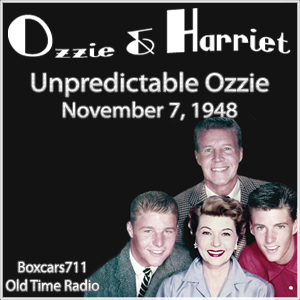
The Adventures Of Ozzie & Harriet - "Unpredictable Ozzie" (11-07-48)

Unpredictable Ozzie (Aired November 7, 1948)

Their sons, David and Ricky, did not join the cast until five years after the radio series began. The two boys felt frustrated at hearing themselves played by actors and continually requested they be allowed to portray themselves. Prior to April 1949, the role of David was played by Joel Davis (1944-45) and Tommy Bernard, and Henry Blair appeared as Ricky. Since Ricky was only nine years old when he began on the show, his enthusiasm outstripped his ability at script reading, and at least once he jumped a cue, prompting Harriet to say, "Not now, Ricky." Other cast members included John Brown as Syd "Thorny" Thornberry, Lurene Tuttle as Harriet's mother, Bea Benaderet as Gloria, Janet Waldo as Emmy Lou, and Dick Trout as Roger. Vocalists included Harriet Nelson, the King Sisters, and Ozzie Nelson. The announcers were Jack Bailey and Verne Smith. The music was by Billy May and Ozzie Nelson. The producers were Dave Elton and Ozzie Nelson. 


THIS EPISODE:

 
November 7, 1948. "Unpredictable Ozzie" - NBC network. Sponsored by: International Silver. Ozzie is determined to break the daily routine and get out of his rut. Ozzie Nelson, Harriet Hilliard, Verne Smith (announcer), John Brown, Tommy Bernard, Janet Waldo, Henry Blair, Lurene Tuttle, Jack Kirkwood, Billy May (composer, conductor). 29:28. Episode Notes From The Radio Gold Index.
Nightwatch - "Drunk & Bridge Jumper" (10-21-54)

"Drunk & Bridge Jumper" (Aired October 21, 1954)

Before the "Reality TV", there was "Reality Radio" and Night Watch was there. This show is a straight crime documentary with no music, sound effects, or actors. Police reporter Don Reid rode in a prowl car on the night shift with officers from the Culver City, California police department. While wearing a hidden microphone, he captures the sounds and voices of real life drama. From the worried child to the hardened criminal, their stories come through loud and clear. The names were changed to protect identities, but everything else in this gripping series is real.


THIS EPISODE:


October 21, 1954. "Drunk & Bridge Jumper"- CBS network. Sustaining. A drunk who tried to kick Don Reed in the teeth last night, has returned to the police station voluntarily. Donn Reed (police recorder), W. N. Hildebrand (Chief of Police), Sterling Tracy (producer, director), Jim Headlock (producer), Ron Perkins (technical advisor). 27:05. Episode Notes From The Radio Gold Index.

Thursday, January 06, 2022

The Man Called X - "The Silver Scarab" (06-19-47)

The Silver Scarab (Aired June 19, 1947)

The Man Called X started over Radio with the 1944 CBS Summer replacement run for Lux Radio Theatre, comprising a total of eight episodes. The only circulating exemplar from the first run is contained within the AFRS Globe Theatre  canon of transcriptions. So, yet again, we are indebted to the incredible output of AFRS and AFRTS transcriptions over the years in preserving some of Radio's rarest exemplars from The Golden Age of Radio. But if one compares that circulating episode to the spot ad for the summer run in the sidebar, one sees the program promoted as a comedy-mystery. The 1944 CBS Summer season finale, Murder, Music and A Blonde Madonna, gives some credence to the way CBS promoted this first run. Starring Herbert Marshall as Ken Thurston, a private operative, with Han Conried as Egon Zellschmidt in this first incarnation of Ken Thurston's nemesis, and Mary Jane Croft appearing in the role of Ken's love interest, Nancy Bessington. Show Notes From The Digital Deli.


THIS EPISODE:


June 19, 1947. CBS network. "The Silver Scarab". Sponsored by: Frigidaire. While in Cairo on the trail of pirate on the Red Sea, Ken Thurston is killed by three silver bullets. Herbert Marshall, Leon Belasco, J. Richard Kennedy (originator), Wendell Niles (announcer), Jack Johnstone (director), Sidney Marshall (writer), Johnny Green (composer, conductor). 26:11. Episode Notes From The Radio Gold Index.
The New Adventures Of Michael Shayne - "The Case Of The Mail Order Murders" (12-23-48)

The Case Of The Mail Order Murders (Aired December 23, 1948)

As with many West Coast ensemble productions of the era, Michael Shayne: Private Detective soon evolved into a very secure set of well-explored character arcs, among which Cathy Lewis' character, Phyllis Knight, found herself more and more integrated into the scripts. Joe Forte's Lieutenant Farraday continued to grow into the role as well. If you're noticing a great many parallels between what you're reading--perhaps for the first time--about Michael Shayne, you might notice the increasing similarities to Let George Do It or Yours, Truly Johnny Dollar. Just as with a good gig, if a good formula is continuing to produce audience loyalty once you find the right ensemble/concept/scripting mix, then you'll naturally wish to milk it for all it's worth. Show Notes From The Old Time Radio Researcher's Group.


THIS EPISODE:
 

December 23, 1948. Broadcaster's Guild syndication, AFRS rebroadcast. "The Case Of The Mail Order Murders". A murder letter and Demetrius, the organ grinder. Jeff Chandler, Jack Webb, William P. Rousseau (host, director), Brett Halliday (creator). 26:17. Episode Notes From The Radio Gold Index.


The Milton Berle Show - "A Salute To Football" (11-04-47)

"A Salute To Football" (Aired November 4, 1947)


The Milton Berle Show brought Berle together with Arnold Stang, later a familiar face as Berle's TV sidekick. Others in the cast were Pert Kelton, Mary Schipp, Jack Albertson, Arthur Q. Bryan, Ed Begley, vocalist Dick Forney and announcer Frank Gallop. The Ray Bloch Orchestra provided the music for the series. Sponsored by Philip Morris, it aired on NBC from March 11, 1947, until April 13, 1948. His last radio series was The Texaco Star Theater, which began September 22, 1948 on ABC and continued until June 15, 1949, with Berle heading the cast of Stang, Kelton and Gallop, along with Charles Irving, Kay Armen and double-talk specialist Al Kelly. It employed top comedy writers (Nat Hiken, brothers Danny and Neil Simon, Aaron Ruben), and Berle later recalled this series as "the best radio show I ever did... a hell of a funny variety show." It served as a springboard for Berle's rise as television's first major star.


THIS EPISODE:


November 04, 1947. NBC network. Philip Morris. "A Salute To Football". Milton goes to see the "Fighting Irish." See cat. #64207 for a similar "salute" but a different broadcast. Frank Gallop (announcer), Milton Berle, Ray Bloch and His Orchestra, Pert Kelton, Jack Albertson, Mary Shipp, Billy Sands, John Gibson, Al Kelly, Dick Farney (vocals). 26:27. Episode Notes From The Radio Gold Index.

The Mysterious Traveler - "Behind The Locked Doors" (11-06-51)

Behind The Locked Doors (Aired November 6, 1951)

Cast members included Jackson Beck, Lon Clark, Roger DeKoven, Elspeth Eric, Wendell Holmes, Bill Johnstone, Joseph Julian, Jan Miner, Santos Ortega, Bryna Raeburn, Frank Readick, Ann Shepherd, Lawson Zerbe and Bill Zuckert. Sound effects were by Jack Amrhein, Jim Goode, Ron Harper, Walt McDonough and Al Schaffer. "Behind the Locked Door," a popular episode which took place in total darkness, was much requested and was repeated several times during the years. The story involves two archaeologists who discover an old wagon train abandoned over one hundred years ago in an old cave. After a landslide traps them in the darkness, they are attacked by apparently human assailants and conclude that the descendants of the wagon train are still living in the cave.


THIS EPISODE:


November 6, 1951. Mutual network. "Behind The Locked Door". Sustaining. A gripping story about a man lost in a pitch black cave with a strangely affectionate creature he cannot see! David Kogan (writer, producer, director), Maurice Tarplin, Robert A. Arthur (writer). 26:36. Episode Notes From The Radio Gold Index.

Space Patrol - "Revolt Of The Space Rats" (11-28-53)

"The Revolt Of The Space Rats" (Aired November 28, 1953)

The success of the TV show spawned a radio version, which ran for 129 episodes from October 1952 to March 1955. The same cast of actors performed on both shows. The writers, scripts, adventures and director were quite different in radio versus TV incarnations. Naturally, the series lacked the adult sophistication of such shows as X Minus One, which focused on adapting short fiction by notable genre names as Robert A. Heinlein and Ray Bradbury. But as a throwback to the sort of Golden Age space opera popularized in the 1930s, the days of science fiction's infancy, by pioneering magazine editor Hugo Gernsback, Space Patrol is prized by OTR collectors today as one of radio's most enjoyable adventures.


THIS EPISODE: 


November 28, 1953. ABC network. "The Revolt Of The Space Rats". Sponsored by: Ralston cereals ("Name The Planet" contest), Test Pilot endorsement. Two bad guys on Pluto's third moon conspire to free Prince Bacaratti once again. Bela Kovacs, Dick Tufeld (announcer), Ed Kemmer, George Welsh (test pilot, commercial), Ken Mayer, Larry Robertson (producer, director), Lou Houston (writer), Lyn Osborn, Mike Devry (executive producer), Mike Mosser (creator), Norman Jolley. 28:52. Episode Notes From The Radio Gold Index.

Wednesday, January 05, 2022

The Adventures Of Frank Race - "The Adventure Of The Silent Tongue" (12-04-49)

The Adventures Of Frank Race - The Adventure Of The Silent Tongue (12-04-49)

The Adventures of Frank Race was a syndicated show, out of Bruce Ells Productions in Hollywood, and began airing on radio in the spring of 1949. A total of 43 episodes were produced, broadcast first on the East coast 1949-50, and then on the West coast 1951-52. The title hero was described in the introduction by announcer Art Gilmore with these words: "Before the war, Frank Race worked as an attorney, but he traded his law books for the cloak-and-dagger of the OSS. When the war was over, his former life was over too....adventure became his business!" Starring "Chandu The Magician"  Star Tom Collins. Tom Collins, having recently completed his leading role as Chandu in the 1948 run of Chandu The Magician, returned to One Man's Family after The Adventures of Frank Race and almost got a bid to portray his Nick Lacey character from One Man's Family for the Television version of the series in 1949.


THIS EPISODE:


December 4, 1949. Program #32. Broadcasters Program Syndicate syndication. "The Adventure Of The Silent Tongue". Commercials added locally. A killer en route to the Chair asks Race to take a pair of baby shoes to his wife. A clue to $2 million bucks? Paul Dubov, Tony Barrett, Buckley Angel (writer, director), Joel Murcott (writer, director), Bruce Eells (producer), Ivan Ditmars (orgainist), Art Gilmore (announcer). 28:36. Episode Notes From The Radio Gold Index.
 

Mr. Keen Tracer Of Lost Persons - "Murder & The Missing Car" (05-11-50)

"Murder & The Missing Car" (Aired May 11, 1950)

When Mr. Keen, Tracer of Lost Persons first debuted over the Blue Network on October 12, 1937, the show’s title accurately described Keen’s stock-in-trade; the “kindly old investigator” tracked down individuals who had mysteriously vanished, leaving behind their families, homes, jobs and other day-to-day activities. Keen (he never had a first name, unless it was “Peachy”) was assisted in these duties by an Irishman named Mike Clancy. Mike wasn’t much of a brainiac (the quote that comprises the title of this post was a semi-catchphrase that he seemed to use on the show every week) but he could use the necessary brawn when the situation called for it. Bennett Kilpack played kindly ol' Keen throughout most of the program’s run, as well as Philip Clarke and Arthur Hughes, while Jim Kelly took the role of Clancy. The series originally aired as a thrice-weekly fifteen-minute serial from 1937-43 (the show moved to CBS in 1942), providing more than ample time for Keen to solve even the most baffling of disappearances.


THIS EPISODE:

 
May 11, 1950. CBS network. "The Case Of Murder and The Missing Car". Sponsored by: Anacin, Kolynos, Heet, Kriptin, Bisodol, Hills Cold Tabs. A body is found in a car trunk...and a false clue is found in the glove compartment. Frank Hummert (originator, producer), Anne Hummert (originator, producer), Bennett Kilpack, Richard Leonard (director), Lawrence Klee (dialogue), Larry Elliott (announcer). 33:58. Episode Notes From The Radio Gold Index.

Jeff Regan Investigator (Starring Jack Webb) - "The Man In The Door" (08-28-48)

 INTRO: The Classic IV "Please Be Mine" (1961) TWIST Records
"The Man In The Door" (Aired August 28, 1948)


Jeff Regan, Investigator was one of the three detective shows Jack Webb did before Dragnet (see also Pat Novak For Hire and Johnny Modero: Pier 23). It debuted on CBS in July 1948. Webb played JEFF REGAN, a tough private eye working in a Los Angeles investigation firm run by Anthony J. Lyon. Regan introduced himself on each show "I get ten a day and expenses...they call me the Lyon's Eye." The show was fairly well-plotted, Webb's voice was great, and the supporting cast were skillful. Regan handled rough assignments from Lion, with whom he was not always on good terms. He was tough, tenacious, and had a dry sense of humor. The voice of his boss, Anthony Lion, was Wilms Herbert. The show ended in December 1948 but was resurrected in October 1949 with a new cast; Frank Graham played Regan (later Paul Dubrov was the lead) and Frank Nelson portrayed Lion. This version ran on CBS, sometimes as a West Coast regional, until August 1950. Both versions were 30 minutes, but the day and time slot changed several times. A total of 29 episodes from this series are in trading currency.


THIS EPISODE:


August 28, 1948. CBS network. "The Man In The Door". Sustaining. A murdered architect is seen alive and well! Jeff looks into a complicated story of murder and embezzlement. Jack Webb, Wilms Herbert, Lou Krugman, Lurene Tuttle, Betty Lou Gerson, Dave Henderson, William Conrad, E. Jack Neuman (writer), Sterling Tracy (producer), Bob Stevenson (announcer), Richard Aurandt (music). 29:46. Episode Notes From The Radio Gold Index.

The Adventures Of Archie Andrews - "JiveTalk" (05-18-46)

"JiveTalk" (Aired May 18, 1946)

Archie Andrews, created in 1941 by Bob Montana, is a fictional character in an American comic book series published by Archie Comics, a long-run radio series, a syndicated comic strip and animation -- The Archie Show, a Saturday morning cartoon television series by Filmation, plus Archie's Weird Mysteries. Archie Andrews began on the Blue Network on May 31, 1943, switched to Mutual in 1944, and then continued on NBC from 1945 until September 5 1953. Archie was first played by Charles Mullen, Jack Grimes and Burt Boyar, with Bob Hastings as the title character during the NBC years.The sponsor was Swift Products. The Cast: Harlan Stone, Alice Yourman, Arthur Kohl, Gloria Mann, Rosemary Rice.


THIS EPISODE:


May 18, 1946. "JiveTalk" - NBC network. Sustaining. Archie and Jughead are hep! Archie tries to get a date with jive talk. It works! Don't miss the young audience tittering when Betty (the sound effects man) gives Archie a kiss. Bob Hastings, Harlan Stone, Alice Yourman, Ian Martin, Gloria Mann, Rosemary Rice, Carl Jampel (writer), Felix McGuire (organist), Charles Urquhart (director), Tex Antoine (announcer). 29:29. Episode Notes From The Radio Gold Index.

Tuesday, January 04, 2022

Life With Luigi - "Life Insurance Policy" (06-26-49)

Life Insurance Policy (Aired June 26, 1949)

Life with Luigi was a radio comedy-drama series which began September 21, 1948 on CBS. The story concerned Italian immigrant Luigi Basco, and his experiences as an immigrant in Chicago. Many of the shows take place at the US citizenship classes that Luigi attends with other immigrants from different countries, as well as trying to fend off the repeated advances of the morbidly-obese daughter of his landlord/sponsor. Luigi was played by J. Carrol Naish, an Irish-American. Naish continued in the role on the short-lived television version in 1952, and was later replaced by Vito Scotti. With a working title of The Little Immigrant, Life with Luigi was created by Cy Howard, who earlier had created the hit radio comedy, My Friend Irma. The show was often seen as the Italian counterpart to the radio show The Goldbergs, which chronicled the experience of Jewish immigrants in New York.


THIS EPISODE:


June 26, 1949. "Life Insurance Policy" - CBS network. Sustaining. Luigi takes out a $50,000 Life Insurance Policy. Next week, "Luigi" becomes the summer replacement for "Lum and Abner," at an earlier time. J. Carrol Naish, Alan Reed, Cy Howard (creator, producer), Hans Conried, Bob Stevenson (announcer), Mac Benoff (writer, director), Lou Derman (writer), Mary Shipp, Lyn Murray (music director), Jody Gilbert, Joe Forte, Ken Peters. 31:31. Episode Notes From The Radio Gold Index.

Boxcars711 Overnight Western "Gunsmoke" - The Buffalo Killers (06-07-52)

Boxcars711 Overnight Western "Gunsmoke"
The Buffalo Killers (Aired June 7, 1952)


Two auditions were created in 1949. The first was very much like a hardboiled detective series and starred Rye Billsbury as Dillon; the second starred Straight Arrow actor Howard Culver in a more Western, lighter version of the same script. CBS liked the Culver version better, and Ackerman was told to proceed. But there was a complication. Culver's contract as the star of Straight Arrow would not allow him to do another Western series. The project was shelved for three years, when MacDonnell and Meston discovered it creating an adult Western series of their own. MacDonnell and Meston wanted to create a radio Western for adults, in contrast to the prevailing juvenile fare such as The Lone Ranger and The Cisco Kid. Gunsmoke was set in Dodge City, Kansas during the thriving cattle days of the 1870s. Dunning notes, "The show drew critical acclaim for unprecedented realism."


THIS EPISODE:


June 07, 1952. CBS network. "The Buffalo Killers". Sustaining. An albino buffalo skin is the clue to the murder of two buffalo hunters, and their father. Part of one promotional announcement has been deleted. Georgia Ellis, Howard McNear, Joel Murcott (writer), Stan Waxman, John Dehner, Lawrence Dobkin, Sam Edwards, Lillian Buyeff, Tom Holland, Mary Lansing, Rex Koury (composer, conductor), Norman Macdonnell (producer, director), Clancey Cassell (announcer), William Conrad, Parley Baer. 30:39.  Episode Notes From The Radio Gold Index.

Beyond Midnight - "Lancerford House" (01-24-69)

Lancerford House (Aired January 24, 1969)

This series was written by Michael McCabe and was produced in South Africa. It was a replacement for another series McCabe produced, called SF68. That series adapted famous Sci-fi stories to radio, and it seems to have been the place where McCabe honed his craft. The subject matter to Beyond Midnight was more horror oriented, including madness, murder, and supernatural sleuths! What survives today doesn't involve a horror host per se, but a few include framing narration (by someone involved in the plot) while others just start up the story with no announcer or lead-in whatsoever. So it's possible the regular host or announcer was left off (edited out) of the recordings. The host-- if there was one-- may have only been heard by those who listened to this series when it first aired. It's another radio mystery we may never know for sure, but we're lucky to at least have some of the recordings!  Show Notes From Radio Horror Hosts.

The Father Brown Mysteries - "The Actor & The Alibi" (11-02-86)

The Actor & The Alibi (Aired November 2, 1986)


When we consider the question of clerics and mysteries, the first figure most of us think of is G.K. Chesterton’s Father Brown. The first Father Brown story was published in 1910 in the Saturday Evening Post, years before Chesterton had even converted to Roman Catholicism. Forty-eight Father Brown stories were published before Chesterton’s death, and for many, the unassuming Catholic priest, who solved mysteries through close observation and intuition, remains the model clerical detective, unmatched by any subsequent efforts by other authors. Not that these authors haven’t tried. Their success depends on the same factors by which we judge any piece of fiction in general and mystery fiction in particular. Father Brown was a natural for radio and he has appeared in several series on both sides of the Atlantic, most notably The Father Brown Stories which were originally broadcast on BBC Radio 4 between 1984 and 1987.

Monday, January 03, 2022

This Is Your FBI - "Shotgun Hadley" (04-20-45)

INTRO: The Classic IV "The Island Of Paradise" (1962) TWIST Records
This Is Your FBI - "Shotgun Hadley" (04-20-45)


Shotgun Hadley (Aired April 20, 1945)

 
This Is Your FBI was sponsored during its entire run by the Equitable Life Assurance Society of the United States (now AXA Equitable Life Insurance Company). This is Your FBI had counterparts on the other networks. The FBI in Peace and War also told stories of the FBI, although some were not authentic. Earlier on, Gangbusters, and the previously mentioned Mr. District Attorney gave the authentic crime treatment to their stories. And Dragnet, and Tales of the Texas Rangers, took the idea on as well. Crime, especially true crime, was a genre in the magazines early on, with the Police Gazette and its predecessors in England printing lurid true crime stories prior to radio. This is Your FBI took the idea, and made it realistic, exciting and even informational. 


THIS EPISODE: 


April 20, 1945. Blue Network. "The Case Of Shotgun Hadley". Sponsored by: The Equitable Life Assurance Society. The story of a crime against the home: kidnapping. Lesley Woods, Frank Lovejoy (narrator), Nathan Van Cleave (music director), Mandel Kramer, Lawrence MacArthur (writer), Jerry Devine (producer), Carl Frank (announcer). 28:25. Episode Notes From The Radio Gold Index.

Our Miss Brooks - "The Tape Recorder" (04-23-50)

The Tape Recorder (Aired April 23, 1950)

Our Miss Brooks, an American situation comedy, began as a radio hit in 1948 and migrated to television in 1952, becoming one of the earlier hits of the so-called Golden Age of Television, and making a star out of Eve Arden (1908-1990) as comely, wisecracking, but humane high school English teacher Connie Brooks. The show hooked around Connie's daily relationships with Madison High School students, colleagues, and pompous principal Osgood Conklin (Gale Gordon), not to mention favourite student Walter Denton (future television and Rambo co-star Richard Crenna, who fashioned a higher-pitched voice to play the role) and biology teacher Philip Boynton ( Jeff Chandler), the latter Connie's all-but-unrequited love interest, who saw science everywhere and little else anywhere.


THIS EPISODE:


April 23, 1950. "The Tape Recorder"- CBS network. Sponsored by: Colgate Toothpaste, Lustre Creme Shampoo, Palmolive Soap. While Mr. Conklin is trying to economize, he finds himself buying a tape recorder, without even knowing it! Eve Arden, Al Lewis (writer, director), Jane Morgan, Richard Crenna, Gale Gordon, Gloria McMillan, Verne Smith (commercial spokesman), Jeff Chandler, Frank Nelson, Bob Lemond (announcer), Larry Berns (producer), Lester White (writer), Joe Quillan (writer), Wilbur Hatch (composer), Maurice Carlton (conductor). 34:45. Episode Notes From The Radio Gold Index.

Boxcars711 Overnight Western "The Roy Rogers Show" - Sid Kenyon Rustlers (04-04-52)

Boxcars711 Overnight Western "The Roy Rogers Show"
"Sid Kenyon Rustlers" (Aired April 4, 1952)

Roy Rogers, born Leonard Franklin Slye (November 5, 1911 – July 6, 1998), was an American singer and cowboy actor, as well as the namesake of the Roy Rogers Restaurants chain. He and his wife Dale Evans, his golden palomino Trigger, and his German Shepherd dog, Bullet, were featured in over one hundred movies and The Roy Rogers Show. The show ran on radio for nine years before moving to television from 1951 through 1957. His productions usually featured a sidekick, often either Pat Brady, (who drove a jeep called "Nellybelle") or the crotchety George "Gabby" Hayes. Roy's nickname was "King of the Cowboys". Dale's nickname was "Queen of the West."


THIS EPISODE:


April 4, 1952. "Sid Kenyon Rustlers" - NBC network. Sponsored by: Post Cereals (pop-out trading cards premium). Lefty Roberts has returned to Paradise Valley with evil intentions. What's wrong with Lefty? Roy Rogers, Dale Evans, Pat Brady, Art Rush (producer), Fran Van Hartesfeldt (writer, director), Milton Charles (music). 31:10. Episode Notes From The Radio Gold Index.

Damon Runyon Theater - "Pick The Winner" (03-20-49)

Pick The Winner (Aired March 20, 1949)


Broadcast from January to December 1949, "The Damon Runyon Theater" dramatized 52 of Runyon's short stories for radio. Damon Runyon (October 4, 1884 – December 10, 1946) was a newspaperman and writer. He was best known for his short stories celebrating the world of Broadway in New York City that grew out of the Prohibition era. He spun tales of gamblers, petty thieves, actors and gangsters; few of whom go by "square" names, preferring instead to be known as "Nathan Detroit", "Big Jule", "Harry the Horse", "Good Time Charlie", "Dave the Dude", and so on. These stories were written in a very distinctive vernacular style: a mixture of formal speech and colorful slang, almost always in present tense, and always devoid of contractions.


THIS EPISODE:


March 20, 1949. Program #12. Mayfair syndication. "Pick The Winner". Commercials added locally. Hot Horse Herbie, Cutie Andrews and Broadway travel to Florida to play the horses. They run into "The Professor," which is a horse of another color! Damon Runyon (author), John Brown, Richard Sanville (director), Russell Hughes (adaptor), Vern Carstensen (production supervisor), Frank Gallop (announcer). 27:49.
Episode Notes From The Radio Gold Index.

Sunday, January 02, 2022

The Chase - "Million Dollar Hunt" (06-29-52)

INTRO: The Commodores - "Three Times A Lady" (1978)
The Chase - "Million Dollar Hunt" (06-29-52)

"Million Dollar Hunt" (Aired June 29, 1952)

NBC first envisioned The Chase  as a new Television feature. This was not uncommon during the later 1940s and early 1950s. Several Radio features straddled both media, with varying success. Developed as a psychological drama, the premise was that many life situations place their subjects in a 'chase' of one type or another. A chase for fame. A chase from peril. A chase to beat the clock. A chase to escape death. The added twist was the question of who is the hunter or the hunted in these situations. The scripts were faced paced, starred quality east coast talent and were well written. The series' plots and themes focused primarily on predominantly fear inducing pursuits of one form or another. Thus most of the scripts were fraught with tension of one type or another. Whether mental tension, physical peril or a mix of both, the abiding theme throughout the series was the the contrasts between the 'hunter' and the 'hunted' in such Life situations. NBC's Television version of The Chase was in production during May 1953. It was to star Doug Fowley as both narrator and performer.


THIS EPISODE:


June 29, 1952. "Million Dollar Hunt" - NBC network. Sustaining. A man robs the bank in which he works. Killing the bank guard and taking $1,000,000 in cash and his greedy wife with him, he begins a desperate attempt to escape to Mexico. Daniel Sutter (director, transcriber), Fred Collins (announcer), Cathleen Cordell, Lawrence Klee (creator, writer), Leon Janney, Scott Tennyson. 29:16. Episode Notes From The Radio Gold Index.

Dragnet - "The Big Grab" (06-29-50)

The Big Grab (Aired June 29, 1950)

Dragnet was a long-running radio and television police procedural drama about the cases of a dedicated Los Angeles police detective, Sergeant Joe Friday, and his partners. The show takes its name from an actual police term, a "dragnet", meaning a system of coordinated measures for apprehending criminals or suspects. Dragnet debuted inauspiciously. The first several months were bumpy, as Webb and company worked out the program’s format and eventually became comfortable with their characters (Friday was originally portrayed as more brash and forceful than his later usually relaxed demeanor). Gradually, Friday’s deadpan, fast-talking persona emerged, described by John Dunning as "a cop's cop, tough but not hard, conservative but caring." 


THIS EPISODE:


June 29, 1950. Program #55. NBC network. "The Big Grab". Sponsored by: Fatima. Professor Kessell's wife has been kidnapped. The show features a moving scene of a Seder. Jack Webb, Barton Yarborough. 29:14.  Episode Notes From The Radio Gold Index.

Boxcars711 Overnight Western "Have Gun Will Travel" - Like Father (09-27-59)

Boxcars711 Overnight Western "Have Gun Will Travel"
Like Father (Aired September 27, 1959)

Paladin lived in the Carlton Hotel in San Francisco, where he dressed in semi-formal wear, ate gourmet food, and attended opera. In fact, many who initially met him mistook him for a dandy from the East. When working, he dressed in black, used calling cards and wore a holster which carried characteristic chess knight emblems, and carried a derringer under his belt. The knight symbol is in reference to his name — possibly a nickname or working name — and his occupation as a champion-for-hire (see paladin). The theme song of the series refers to him as "a knight without armor." In addition, Paladin drew a parallel between his methods and the chess piece's movement: "It's a chess piece, the most versatile on the board. It can move in eight different directions, over obstacles, and it's always unexpected." Paladin was a former Army officer and a graduate of West Point.


THIS EPISODE:


September 27, 1959. CBS network. "Like Father". Sponsored by: Winston. Klell Thomas has been accused of murder in Yreka. Paladin is hired to find the truth. This is a quality upgrade, network, sponsored version. John Dehner, Virginia Gregg, Paul Dubov, Hugh Douglas (announcer), Frank Paris (producer, director), Tom Hanley (writer, sound effects), Anne Morrison, Jack Moyles, Ben Wright, Shirley Mitchell, Ralph Moody, Sam Edwards, Bill James (sound effects), Sam Rolfe (creator), Herb Meadow (creator). 23:28. Episode Notes From The Radio Gold Index.

Cloak & Dagger - "Brenner Pass Story" (06-04-50)

Brenner Pass Story (Aired June 4, 1950)

"Are you willing to undertake a dangerous mission for the United States, knowing in advance you may never return alive?" Cloak and Dagger first aired over the NBC network on May 7, 1950. It had a short run through the Summer on Sundays, changing to Fridays after its Summer run. The last show aired Oct. 22, 1950. This is the story of the WWII special governmental agency, the OSS, or Office of Strategic Services. Its mission was to develop and maintain spy networks throughout Europe and into Asia, while giving aid to underground partisan groups and developing espionage activities for Allied forces overseas.The show is based on the book of the same name by Lt. Col. Corey Ford and Major Alastair MacBain (who were associated with the OSS from its early days.) The dramas are not Hollywood-style, in that they sometimes end with plans foiled or leading characters dead.


THIS EPISODE:


June 4, 1950. NBC network. "The Brenner Pass". Sustaining. 4:00 P. M. Donald Harper, who was assigned to blow up an Italian highway and who succeeded with the help of a beautiful woman. Even though this O. S. S. agent did not live, his mission was a success. Hester Sondergaard, Boris Aplon, Sherman Marks (director, supervisor), Berry Kroeger, Virginia Payne, Raymond Edward Johnson, Karl Weber, Winifred Wolfe (writer), Louis Sorin, Jon Gart (music director), Louis G. Cowan (producer), Alfred Hollander (associate producer), Corey Ford (originator), Joseph Julian, Everett Sloane, Alistair MacBain (originator). 29:11. Episode Notes From The Radio Gold Index.

Duffy's Tavern - "Guests Jimmy Durante & Ann Sothern" (03-30-49)

Guests Jimmy Durante & Ann Sothern (Aired March 30, 1949)

Duffy's Tavern, an American radio situation comedy (CBS, 1941-1942; NBC-Blue Network, 1942-1944; NBC, 1944-1952), often featured top-name stage and film guest stars but always hooked those around the misadventures, get-rich-quick-scheming, and romantic missteps of the title establishment's malaprop-prone, metaphor-mixing manager, Archie, played by the writer/actor who co-created the show, Ed Gardner. In the show's familiar opening, "When Irish Eyes Are Smiling," either solo on an old-sounding piano or by a larger orchestra, was interrupted by the ring of a telephone and Gardner's New Yorkese accent as he answered, "Duffy's Tavern, where the elite meet to eat. Archie the manager speakin'. Duffy ain't here — oh, hello, Duffy." Duffy, the owner, was never heard (or seen, when a film based on the show was made in 1945 or when a bid to bring the show to television was tried in 1954).


THIS EPISODE:


March 30, 1949. NBC network origination, Nostalgia Broadcasting Corporation syndication. Commercials added locally. "Guests Jimmy Durante and Ann Sothern" star in Archie's play, "The Mystery Of The Laughing Piano," or "Who Tickled The Ivories?" Ed Gardner does not appear on the program! Eddie Green, Charlie Cantor, Jimmy Durante, Ann Sothern, Matty Malneck and His Orchestra. 29:47. Episode Notes From The Radio Gold Index.

Saturday, January 01, 2022

Dangerous Assignment - "Intercept Dr. Korvel" (Aired December 30, 1950)

INTRO: The Carpenters "Only Yesterday" (1975)
Dangerous Assignment - Intercept Dr. Korvel (12-30-50)


This thirty-minute international spy adventure featured Steve Mitchell (Brian Donlevy), and investigator of crimes in exotic locations. 60 episodes. Herb Butterfield played the Commissioner and Betty Moran was the Commissioner's secretary. Other cast members were GeGe Pearson, Ken Peters, Betty Lou Gerson, Dan O’Herlihy. The director was Bill Cairn and the writer for the series was Robert Ryf. The opening was the same every week “Yeah, danger is my assignment. I get sent to a lot of places I can’t even pronounce. They all spell the same thing though, trouble.” He would be summoned to his boss’s office where he would be given his assignment; he would then fly halfway across the globe to save the day! The worldwide locations are dealt up with a feeling of local, and the characters that inhabit these far-away places with strange sounding names are solid and capably acted by veterans. Music is an almost harsh orchestra. Donlevy carries the plots with a world-weary and wary tone that makes sense, based on his occupation.


The Life Of Riley - "Riley Finds A Fox Fur Coat" (04-06-46)

Riley Finds A Fox Fur Coat (Aired April 6, 1946)

The radio program starring William Bendix aired on the ABC Blue Network from January 16, 1944 to June 8, 1945. Then it moved to NBC, where it was broadcast from September 8, 1945 to June 29, 1951. The supporting cast featured John Brown, who portrayed not only undertaker Digger O'Dell but also Riley's co-worker Gillis. Whereas Gillis gave Riley bad information that got him into trouble, Digger gave him good information that "helped him out of a hole," as he might have put it. Brown's lines as the undertaker were often repetitive, including puns based on his profession; but, thanks to Brown's delivery, the audience loved him.


THIS EPISODE:


April 6, 1946. NBC network. Sponsored by: Teel, Dreft. "Riley Finds A Fur Coat" on the bus and wins an argument with his conscience. William Bendix, Ken Carpenter (announcer), Frank Nelson, Paula Winslowe, Dink Trout, John Brown, Scotty Beckett, Elvia Allman, Irving Brecher (producer), Don Bernard (director), Lou Coslowe (music), Sharon Douglas. 27:39. Episode Notes From The Radio Gold Index.
Radio City Playhouse (NBC) - "Ground Floor Window" (07-10-48)

Ground Floor Window (Aired July 10, 1948)


The Radio City Playhouse was a half-hour of drama, sometimes comedy, often very exciting and suspenseful. The cast were made up of New York veterans of radio and stage, including Jan Minor and John Larkin as featured performers. The director, Harry W. Junkin, also served as the show's host and narrator. Each week the show introduced a new story, often written by well-known writers of fantasy and suspense such as Ray Bradbury, Cornell Woolrich, Agatha Christie and Paul Gallico. They were dramatized with a full orchestral soundtrack and excellent sound effects.


THIS EPISODE:
 

July 10, 1948. Program #2. NBC network. "Ground Floor Window". Sustaining. The script was subsequently used on "Radio City Playhouse" on October 23, 1949. Ernest Kinoy (writer), William Redfield, Harry W. Junkin (director), Bernard Grant, Marilyn Erskine, Anna Karen, Arthur Q. Bryan, Roy Shield (composer, conductor), Richard P. McDonough (NBC supervisor), Bob Warren (announcer). 28:38. Episode Notes From The Radio Gold Index.

The Whisperer - "Never The Twain" (09-16-51)

"Never The Twain" (Aired August 19, 1951)

The Whisperer was an American old-time radio show broadcast from July 8 to September 30, 1951 on NBC. It ran for only 13 episodes. The premise of the series was as improbable as its storylines. The protagonist was Philip Gault (Carleton G. Young), a lawyer who, due to some unexplained accident, lost his voice and could only speak in an eerie whisper. Gault infiltrates "the syndicate" in his native Central City to bring down organized crime from within; to the underworld, he becomes known as the Whisperer. Later, his voice is restored through surgery, but he continues to lead a double life as the Whisperer, relaying instructions from the syndicate bosses in New York (who don't know he's a mole) to their lackeys in Central City, whom Gault is actually setting up. By today's standards, the stories are dated and their message-mongering usually criticized as ham-fisted, the product of what might be considered the unenlightened attitudes of the time. The first episode ("Tea Time for Teenagers") is typical, an overwrought "it can happen here" melodrama about a syndicate plot to create "200 regular marijuana addicts" among high school students. The episode makes a blatant appeal to the moral indignation of its audience, ending with Gault advising PTA's to "show some of the fine educational films available on marijuana and how it leads to a worse addiction."